Build a website with ChatGPT
Ask ChatGPT for a website. Get a real one, online.
A real example: Biscuit & Bramble
You, message 1
Use LazyFrog to build a website for my dog grooming business, Biscuit & Bramble, in York. I'd like a home page that says what we do, our services with prices, our opening hours (Monday to Friday 8:30 to 17:00, Saturday 9:00 to 13:00) and a form where people can ask for an appointment: their name, email, their dog's name and breed, the service they want and a preferred date.
Codex: Read LazyFrog's guide, made a project with a private preview, saved a short plan with a look for the business, and asked two questions: the real prices or placeholders, and how to hear about appointment requests. Then it waited. Nothing was built yet.
You, message 2
1a. Our prices: full groom £45 for small dogs, £55 for medium and £65 for large; bath and brush-out £30; nail trim £10; puppy introduction £25. 2b. Use stock photos of dogs for now. This is an example site, so add a small note at the top saying it's an example made with Codex on LazyFrog and not a real business, and leave out an address and phone number. Write the words yourself. Go ahead and build it.
Codex: Applied the look, picked two licensed stock photos of dogs, wrote the page with the prices and hours, and set the form to keep each request in the site's own database. It tried the phone menu and a request in a real browser, checked the page at phone, tablet and laptop widths, and acted on what the check suggested.
You, message 3
It looks great. Publish it.
Codex: Ran a test publish, then published, and checked the live site.
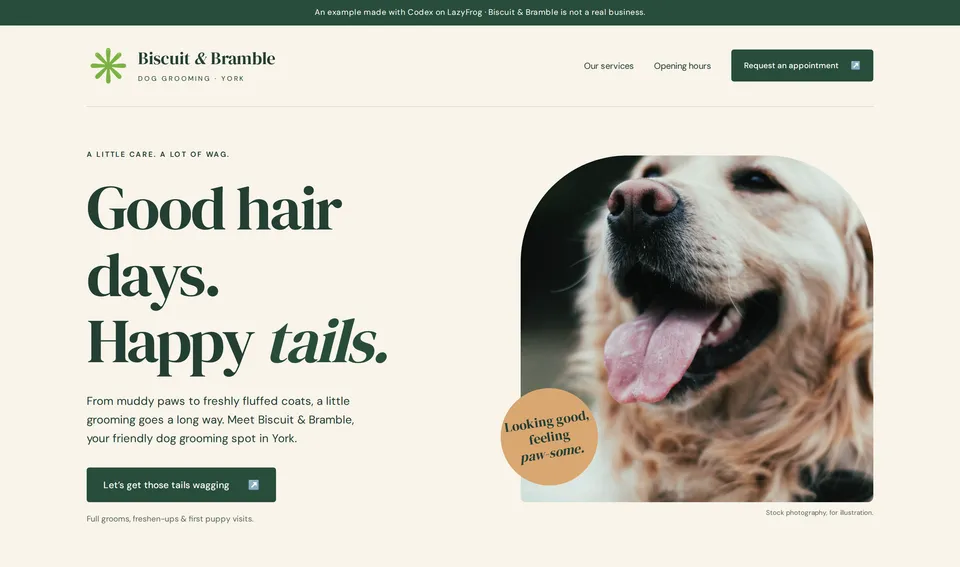
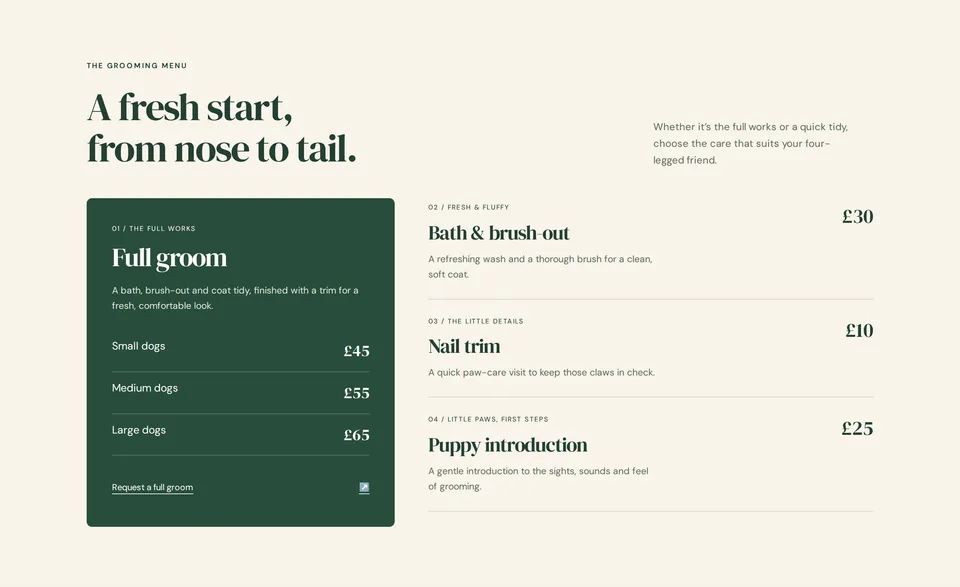
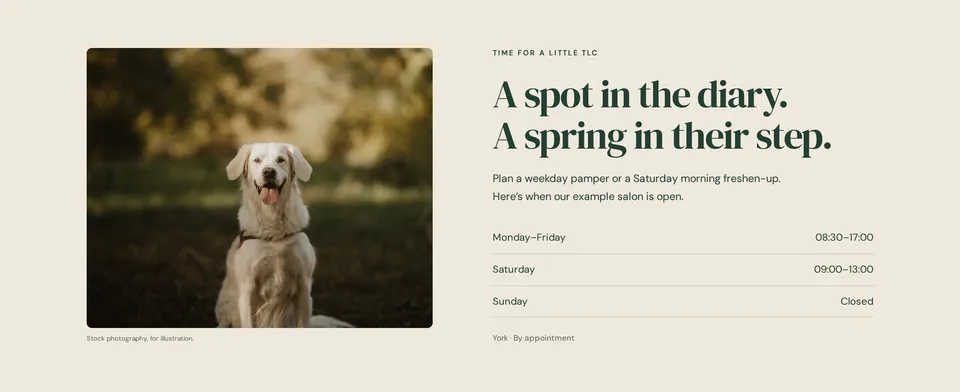
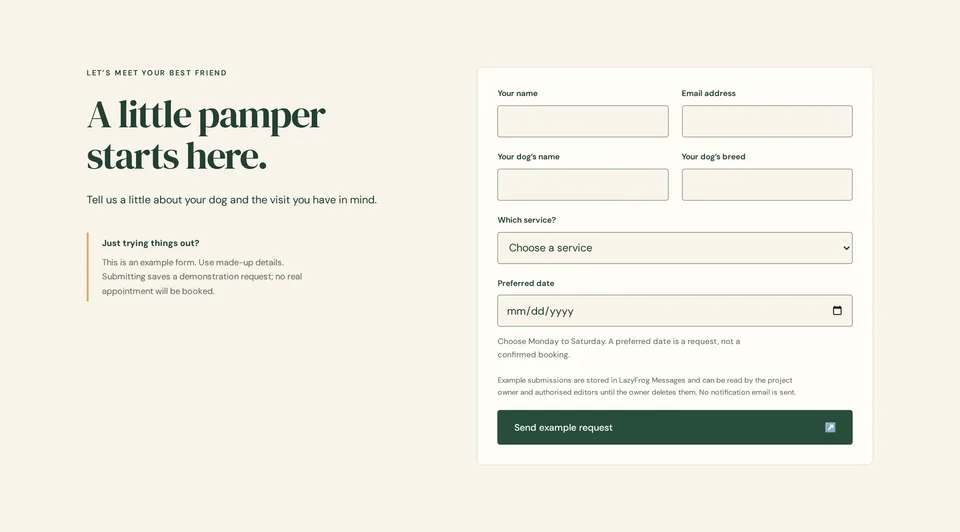
Screenshots of the live site. The photos are licensed stock photos Codex chose, until the business sends its own. Made in Codex, OpenAI's coding agent, which you sign in to with your ChatGPT account; in the ChatGPT app, on the web and on the phone, it works the same way, through the same LazyFrog connector.
How it works
- 1.Connect LazyFrog to ChatGPT once. On a computer, at chatgpt.com, add LazyFrog as a custom MCP server and sign in (the steps). After that it's in the ChatGPT phone app too.
- 2.Ask for your website in your own words. ChatGPT asks the few things only you know, shows a short plan, and waits for your yes. It may ask you to approve its changes; that's normal.
- 3.Check the preview, then say “publish”. The preview has its own private address while you build. Publishing puts the site at name.lazyfrog.app, or at your own domain.
What you get that a chat alone can't give you
- A real address: name.lazyfrog.app, or your own domain.
- Forms that work: every message is saved in your site's own database, and you see it in your LazyFrog account or get it by email.
- A database for anything that keeps data, such as bookings, orders or members.
- Undo: every change is recorded, and ChatGPT can go back to an earlier version.
- Changes later, the same way: open a new chat and ask, for example “change the opening hours”.
- Code that's yours: a git repository you can take anywhere.
Already made something in ChatGPT, or a ChatGPT Site? Turn it into a real website. Side by side: LazyFrog vs ChatGPT Sites.
What it costs
- Building and trying is free: one project with a database and a preview. Free has no live site.
- Publishing starts with Hobby at $9 a month (excluding VAT and sales tax): 3 projects, a live site and your own domain. Pro is $29 and Business $79.
- LazyFrog never charges for ChatGPT's work and sells no AI credits. Building uses your ChatGPT plan's usage, like any chat.
Good to know
- There is no editor to learn. ChatGPT does the building, and you change things by asking.
- ChatGPT doesn't take photos. It uses your own photos or licensed stock photos, and can draw simple icons and illustrations.
- Read what ChatGPT wrote about your business before you publish, and send it the real details.
- A site with no visitors sleeps after 15 quiet minutes and wakes in a few seconds. Hobby keeps one live site always on.
Questions
- Do I need to know how to code?
- No. You describe the website in your own words, ChatGPT writes the code, and you check the result in the preview. To change something later, you ask ChatGPT in a new chat.
- Which ChatGPT plans work?
- Any ChatGPT account that can add a custom MCP server. We've used it on the free plan and on Plus; OpenAI decides which plans have it and changes the menus from time to time. You add it once on a computer, and then it's in the ChatGPT phone app too.
- Is this ChatGPT Sites?
- No. Sites is OpenAI's own hosting for a website you describe in ChatGPT or Codex. On LazyFrog your site gets a server of its own, a PostgreSQL database, scheduled jobs when it needs them, and its code in your own git repository. Our LazyFrog vs ChatGPT Sites page puts them side by side.
- Is LazyFrog a website builder like Wix or Squarespace?
- No. There is no editor to learn: ChatGPT does the building, and LazyFrog is where the website lives, with its preview, its database, its address and its undo. You change things by asking ChatGPT.
- Can I use my own domain?
- Yes, from the Hobby plan. Buy the name anywhere you like, and ChatGPT tells you the records to add where you bought it. Your site is also always at name.lazyfrog.app.
- What if ChatGPT breaks something?
- Nothing goes live until you say publish. Every change is recorded, so ChatGPT can undo the last one or go back to an earlier version of the code, the data and the files.
- Can I take my website somewhere else later?
- Yes. Every project is a git repository you can clone, and an export carries your data and the steps to run it anywhere.
- Is the Biscuit & Bramble example real?
- The website is real: Codex, OpenAI's coding agent, built and published it on LazyFrog on 12 November 2026 from the three messages shown on this page. The business is made up, and the site says so at the top.